


Bee, Wasp, or Yellowjacket? How to Tell Which Stinging Insect Is at Your SoCal Home
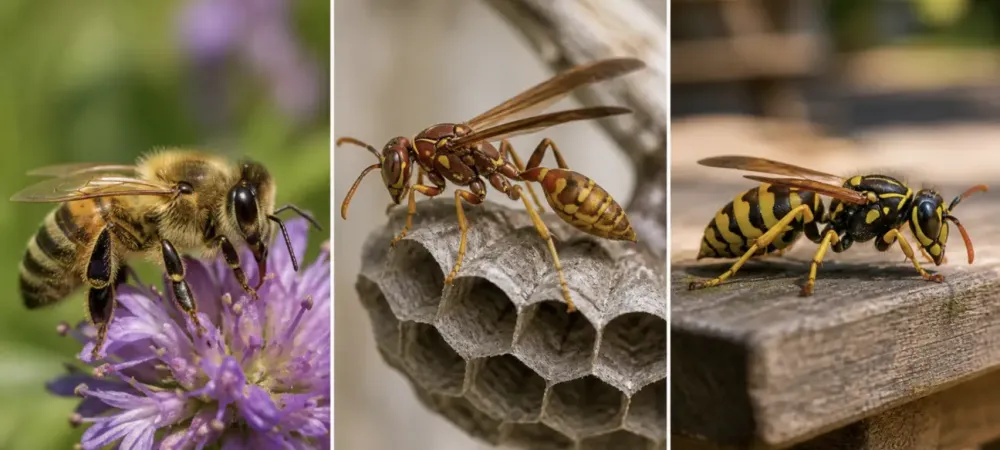
Honey bees are fuzzy and golden-brown, yellowjackets are smooth and shiny with sharp yellow and black bands, and paper wasps are slender with long legs that dangle in flight. Where the nest sits is the second clue. Yellowjackets often nest underground or inside wall voids, paper wasps build open, umbrella-shaped combs under eaves, and honey bees build wax comb inside cavities like walls, meter boxes, and hollow trees. Knowing which insect you're dealing with tells you how much risk the nest carries.
- How do you tell bees, wasps, and yellowjackets apart?
- Why are yellowjackets more aggressive in late summer and fall?
- Do yellowjacket nests die off in winter in Southern California?
- Should you treat a honey bee swarm in Southern California as Africanized?
- Why is DIY wasp and yellowjacket nest removal risky?
- Are carpenter bees and bumble bees dangerous?
- When should you call a professional for a stinging insect nest?
How do you tell bees, wasps, and yellowjackets apart?
Bees, wasps, and yellowjackets differ in body type, nest style, and how they behave around people. UC Statewide IPM notes that honey bees are hairier and less brightly striped than yellowjackets, which is the fastest visual check.
| Honey bee | Yellowjacket | Paper wasp | Carpenter bee | |
|---|---|---|---|---|
| Look | Fuzzy, golden-brown, muted stripes | Smooth, shiny, bright yellow and black bands | Slender waist, long dangling legs | Large, shiny black abdomen with little hair |
| Nest | Wax comb inside walls, meter boxes, trees | Papery nest underground, in wall voids, or in attics | Open, umbrella-shaped comb under eaves and patio covers | Round holes drilled into untreated wood |
| Sting | Stings once, stinger stays in the skin | Can sting repeatedly | Can sting repeatedly | Females can sting but rarely do |
| Around people | Calm away from the colony, defensive near it | Persistent around food and trash, very defensive at the nest | Usually calm unless the nest is disturbed | Males hover and dive but can't sting |
Why are yellowjackets more aggressive in late summer and fall?
Yellowjackets get more aggressive in late summer and fall because their colonies are at their largest while natural food is getting scarce. UC IPM reports that defensive behavior increases as the season goes on, and that a single colony can reach 1,500 to 15,000 yellowjackets depending on the species. In fall, foraging yellowjackets switch to scavenging, which puts them at barbecues, trash cans, pet food bowls, and fallen fruit. That's when most Southern California homeowners run into them.
Do yellowjacket nests die off in winter in Southern California?
Yellowjacket nests don't reliably die off in winter in coastal Southern California. Most yellowjacket colonies last a single season, but UC IPM notes that in mild winters and in coastal California south of San Francisco, some colonies survive for several years and grow very large. A nest you noticed in October isn't guaranteed to be gone by spring, and a multi-year nest is more dangerous to disturb than a new one.
Should you treat a honey bee swarm in Southern California as Africanized?
Any honey bee swarm or colony in Southern California that isn't kept by a beekeeper should be treated as Africanized. UC Riverside advises that once an area is well colonized, all unmanaged honey bees should be assumed Africanized, and UC IPM reports that Africanized honey bees have colonized every Southern California county. Africanized bees look nearly identical to European honey bees but defend their nests in greater numbers and with less warning.
Don't spray it, knock it down, or try to move it. Keep kids and pets away, and go inside a building or car if bees start following you. Then call a pest control company to remove it. UC ANR's Africanized honey bee fact sheet gives the same advice: leave nests and swarms alone and let a professional handle them.
Why is DIY wasp and yellowjacket nest removal risky?
DIY nest removal is risky because disturbing a nest triggers the whole colony to defend it, and yellowjackets can sting repeatedly. UC IPM warns that even at night, when wasps are most likely to be in the nest, and even with sprays that shoot a stream up to 20 feet, stings are still likely. Agitated wasps can also be found some distance from the nest the day after a treatment.
The popular fixes make things worse. Pouring gasoline into a ground nest creates a fire hazard and contaminates soil. Flooding a nest with a hose just scatters angry yellowjackets. A partial treatment leaves a colony alive and on alert.
Are carpenter bees and bumble bees dangerous?
Carpenter bees and bumble bees rarely sting and are much less defensive than yellowjackets or honey bees. Bumble bees will defend a nest if it's disturbed, but they usually leave people alone. Carpenter bees are more of a property problem than a safety one, since the females drill round holes into untreated wood like fascia boards, eaves, and patio beams to lay their eggs. the bugman Termite & Pest Control handles both through stinging insect control.
When should you call a professional for a stinging insect nest?
You should call a professional for a stinging insect nest when any of these apply:
- The nest is near a door, walkway, play area, or pool.
- Someone in your home is allergic to stings.
- The nest is inside a wall, attic, or the ground, where you can't see its full size.
- The insects are honey bees, which should be treated as Africanized in Southern California.
- A nest you removed yourself is active again.
the bugman Termite & Pest Control's stinging insect service starts with an inspection to find nests and identify the insect, followed by safe removal and recommendations to keep them from coming back. If you want to know more about how nests take shape, read how wasps build their nests.
Found a nest and not sure what's living in it?
Request a free quote from the bugman Termite & Pest Control and we'll help you figure out the right next step.